Each-Way Betting UK: Place Payouts and Odds
 Available in US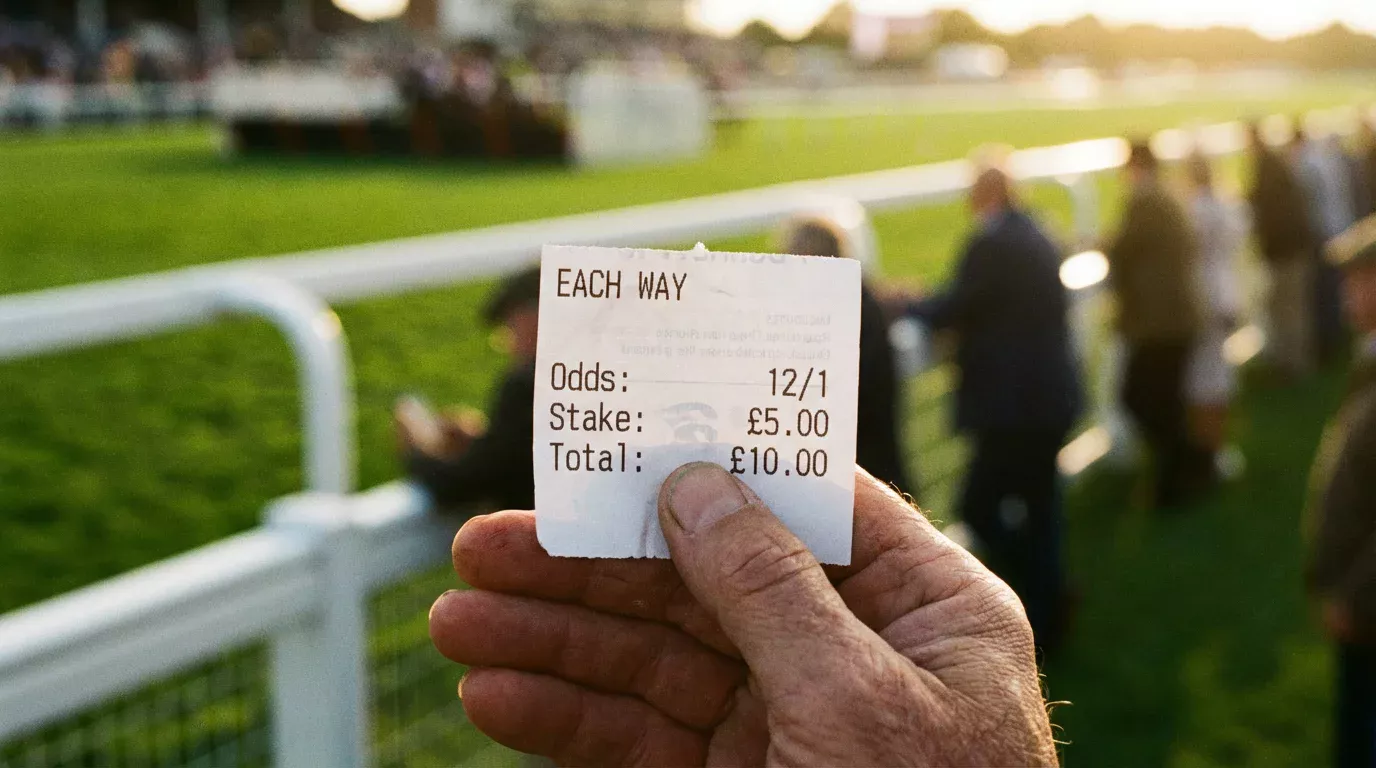
Table of Contents
- UK Racecourses Each-Way Betting Default Strategies
- The Two-Part Structure: Win Leg and Place Leg
- How Place Odds Are Calculated from Win Odds
- Placing an Each-Way Bet: Step-by-Step Example
- Scenarios Where Each-Way Outperforms a Win Bet
- Where New Bettors Misread Each-Way Mechanics
- Each-Way Doubles, Trebles, and Accumulators
- Frequently Asked Questions
- Sources
UK Racecourses Each-Way Betting Default Strategies
I placed my first each-way bet at Newbury in 2017, on a 14/1 shot in a novice hurdle. The horse ran a blinder, finished third, and I walked away with a profit despite never seeing it cross the line first. That moment crystallised something I have spent nine years confirming with data: each-way betting is the backbone of UK racing for a reason.
The numbers bear this out. Each-way wagers account for roughly 22% of the entire horse racing betting market in Britain — second only to straight win bets at 36%. That is not a niche product; it is the default setting for hundreds of thousands of punters who walk into a betting shop, load up a mobile app, or queue at a Tote window on race day. And if you have ever wondered why the UK betting landscape looks so different from the American one, this is a large part of the answer. The relationship between racing and betting in Britain stretches back over 200 years, creating a market where the each-way bet evolved as the natural middle ground between caution and ambition.
What makes each-way so deeply embedded in British racing culture is its dual personality. You are not simply picking a winner — you are making two simultaneous bets on the same horse: one to win and one to finish in the places. That structure gives you a safety net without abandoning the upside. It is the reason you will hear “five pounds each way” more often than any other phrase in a betting ring, and the reason casual punters and seasoned analysts alike treat it as their starting point. In a sport where most races are won by a horse that was not the clear market leader, having a second chance through the place leg is not a luxury — it is sensible bankroll management disguised as a simple bet.
This guide breaks down the full mechanics of each-way betting for UK racing, from the two-part structure and the place odds calculation to the step-by-step process of placing one and the scenarios where it genuinely outperforms a straight win bet. If you are new to each-way, this is your foundation. If you have been betting each-way for years without fully understanding the maths, you are not alone — and this will fill the gaps. For a broader overview of how each-way fits into the win and place betting landscape, that guide covers the full picture.
To accurately determine your potential returns before the race begins, we highly recommend using a reliable place bet calculator to run the numbers.
The Two-Part Structure: Win Leg and Place Leg
Think of an each-way bet as two separate tickets stapled together. You hand over one stake, but the bookmaker treats it as two. A “five pounds each way” bet costs you ten pounds in total: five on the horse to win and five on the horse to place. These two legs live independent lives — they are settled separately, they pay out at different odds, and one can win while the other loses.
The win leg is straightforward. Your horse needs to cross the finish line first. If it does, you collect winnings at the full advertised odds — exactly what you would receive from a straight win bet. There is no discount, no reduction, no catch. The win part of an each-way bet is identical to a standalone win wager.
The place leg is where each-way earns its reputation. Your horse does not need to win. It needs to finish in the “places” — a predefined number of top finishing positions that varies depending on the race. In a standard race with eight or more runners, the places are first, second, and third. In a handicap with sixteen or more runners, the places extend to first, second, third, and fourth. Fewer than five runners, and there is no place market at all — your each-way bet becomes a win-only bet. The place leg pays out at a fraction of the win odds, typically one quarter (1/4) or one fifth (1/5) of the full price, depending on the race type.
Here is where it gets interesting. If your horse wins, both legs pay out. You collect the full win odds on the win leg and the fractional place odds on the place leg. If your horse finishes second or third (or fourth in a large handicap), the win leg is a loser — you lose that five pounds — but the place leg pays. And if your horse finishes outside the places, both legs lose and you are down the full ten pounds.
This dual structure is why each-way betting suits a wider range of outcomes than a win bet. You are not banking everything on one result. You have two separate paths to a return, and in races with bigger fields and longer-priced runners, that second path through the place leg can be remarkably profitable on its own. I have had plenty of months where the place legs alone kept my overall each-way record in the black, even when my win strike rate was underwhelming.
One detail that catches beginners: the “each-way” label means your total outlay is always double the stated stake. When someone says “I had a tenner each way”, they spent twenty pounds. This is not a quirk — it is the fundamental mechanic. You are placing two bets, and the bookmaker charges accordingly. Understanding this from the outset saves confusion when you see twice the expected amount deducted from your account balance.
How Place Odds Are Calculated from Win Odds
The place odds on your each-way bet are not pulled from thin air. They are derived directly from the win odds using a fixed fraction — and that fraction is dictated by the type of race, not by the bookmaker’s mood. Getting comfortable with this calculation is the single most useful thing a new each-way bettor can learn, because it turns a seemingly complex bet into basic arithmetic.
In the vast majority of UK races, the place fraction is 1/4. That means the place odds are one quarter of the win odds. If your horse is priced at 8/1, the place odds are 2/1 (eight divided by four). If the win price is 12/1, the place leg pays at 3/1. If the win price is 20/1, the place odds are 5/1. The pattern is simple: take the numerator, divide by four, and that is your place price.
Certain races use a 1/5 fraction instead. This typically applies to races with five, six, or seven runners where only two places are paid. At 1/5, a horse priced at 10/1 gives you place odds of 2/1 (ten divided by five). The reduced fraction reflects the reduced number of paid places — fewer finishing positions qualify, so the bookmaker offers a smaller fraction of the win odds.
A typical bookmaker overround for an average race sits between 110% and 125%, but the overround on the place market is significantly higher because each runner’s place probability is compressed into a smaller payout fraction. Betfair Exchange back markets, by comparison, settle closer to 101-102%. That gap between bookmaker place margins and exchange odds is something experienced each-way bettors learn to exploit — but even at standard bookmaker odds, knowing the fraction lets you instantly calculate whether a place return justifies the double outlay.
Here is a quick mental shortcut I use at the racecourse. For 1/4 odds races: divide the first number by four, keep the second number. So 16/1 becomes 4/1. For 1/5 races: divide by five. So 15/1 becomes 3/1. If you can do that division in your head, you can evaluate any each-way bet in seconds — long before the app calculates it for you.
Placing an Each-Way Bet: Step-by-Step Example
Over 80% of bets at the 2024 Cheltenham Festival were placed via mobile, and each-way wagers surged 25% across the four days. That tells you something: the vast majority of each-way bets in Britain now happen on a phone screen, not at a betting window. Let me walk through the full process using a realistic race-day example so you can see exactly what happens at each stage.
Imagine a twelve-runner handicap hurdle at Cheltenham. You fancy a horse called Northern Star, priced at 10/1. The race has twelve runners, so standard place terms apply: three places paid at 1/4 odds. You decide to bet five pounds each way.
Your total stake is ten pounds — five on the win leg and five on the place leg. On most betting apps, you enter “5” in the stake box, tick the “each-way” checkbox, and the app will display the total cost as ten pounds. The bet slip should also show the place terms: “1/4 odds, 3 places” or similar wording. Always check this before confirming — place terms vary by race, and not every app makes them equally visible.
Now the race runs. Three possible outcomes:
Northern Star wins. The win leg pays at 10/1: five pounds times ten equals fifty pounds profit, plus your five-pound stake back, totalling fifty-five pounds. The place leg also pays, because a winner is automatically “placed”. Place odds are 10/1 divided by four, which gives 2.5/1 (or 5/2). Five pounds at 5/2 equals twelve pounds fifty profit, plus your five-pound stake back, totalling seventeen pounds fifty. Grand total returned: seventy-two pounds fifty. Profit after deducting your ten-pound total stake: sixty-two pounds fifty.
Northern Star finishes second or third. The win leg loses — you forfeit the five-pound win stake. The place leg pays at 5/2: twelve pounds fifty profit plus your five-pound place stake back, totalling seventeen pounds fifty returned. Deduct your original ten-pound total outlay: net profit of seven pounds fifty. Not a headline-grabbing return, but a genuine profit from a horse that never won.
Northern Star finishes fourth or worse. Both legs lose. You are down ten pounds.
That middle scenario is the heart of each-way betting. A horse at 10/1 has roughly a 9% implied chance of winning but a considerably higher chance of finishing in the top three. The place leg monetises that wider probability window. Over hundreds of bets, those place returns accumulate — and in my experience, they are the difference between a losing year and a breakeven one for most recreational punters.
Scenarios Where Each-Way Outperforms a Win Bet
Not every race is an each-way race. I have learned this the hard way — betting each-way on a 6/4 shot in a five-runner Group 1 is a reliable way to bleed money. But there are clear, repeatable scenarios where each-way consistently outperforms a straight win bet, and recognising them is what separates reactive punting from deliberate strategy.
Large handicap fields are the classic each-way territory. When a race has sixteen or more runners, four places are paid instead of three, and the place fraction remains at 1/4. That fourth place is a genuine gift. A 20/1 outsider in a twenty-runner handicap has a realistic chance of finishing in the first four — far more realistic than its implied 4.8% win probability suggests. The place leg at 5/1 from a five-pound each-way bet returns thirty pounds on the place alone, which comfortably covers the ten-pound total outlay and delivers a twenty-pound profit even when the horse does not win. In big handicaps, the winner frequently comes from outside the top three in the market, and each-way punters on those longer-priced runners collect more often than win-only backers.
Festival racing amplifies this dynamic. The Cheltenham Festival, the Grand National, Royal Ascot’s big handicaps — these are events where competitive fields, unpredictable ground conditions, and the sheer intensity of the occasion combine to produce results that favour breadth over precision. The place market thrives on chaos, and festivals deliver chaos reliably.
Races where the favourite is vulnerable but the form points to several contenders are another sweet spot. If you believe a horse has a genuine chance of hitting the frame but not necessarily winning — perhaps it stays on well in the closing stages but lacks a finishing kick — each-way captures that profile perfectly. A win bet demands first place. Each-way gives you three or four ways to profit.
Conversely, each-way is a poor choice when your horse is short-priced. At 2/1, the place leg pays just 1/2 (at 1/4 odds), meaning a five-pound place stake returns only seven pounds fifty — barely covering the place stake itself. You are effectively paying double for a place return that adds almost nothing. In small fields, short-priced races, or situations where you have strong conviction about a single horse, a straight win bet is cleaner and more capital-efficient.
For more expert insights and daily market updates, explore our top UK horse racing betting guide to stay ahead of the bookmakers.
Where New Bettors Misread Each-Way Mechanics
A friend of mine once placed a “ten-pound each-way” bet expecting to spend ten pounds. He was genuinely confused when his account showed a twenty-pound deduction. That confusion is so common it might as well be a rite of passage for new punters — and it is entirely the fault of the terminology. “Ten pounds each way” sounds like one ten-pound bet. It is two. The double-stake mechanic is the single most misread element of each-way betting, and failing to grasp it leads to overstaking before the first furlong.
The second mechanical trap is assuming place terms are universal. They are not. A five-runner conditions race pays two places at 1/4 odds. An eight-runner maiden pays three places at 1/4 odds. A sixteen-runner handicap pays four places at 1/4 odds. Some bookmakers offer enhanced terms on selected races — extra places, for instance — but the standard terms shift depending on runner count and race type. Placing an each-way bet without checking the place terms specific to your race is like driving without checking the speed limit. You might be fine, but you might also be working with the wrong numbers entirely.
The third misunderstanding is about what “placed” means when your horse wins. I have seen new bettors assume they only get the win payout if their horse comes first, forgetting that the place leg also pays on a winner. Both legs settle in your favour when the horse wins — the win leg at full odds, the place leg at the fractional odds. Missing this means underestimating the total return of each-way on a winning selection, which in turn leads to undervaluing the bet type.
Finally, there is the “each-way on everything” habit. Some beginners tick the each-way box as a default, regardless of price or field size. Each-way on a 5/4 favourite in a six-runner race is almost never sensible. The place fraction shrinks the return to near-nothing, while the double stake inflates the cost. Each-way is a tool with specific use cases — not a universal setting. The discipline is knowing when not to use it.
Each-Way Doubles, Trebles, and Accumulators
Once you understand single each-way bets, the natural next step is multiples — and this is where each-way gets genuinely exciting, if you can handle the maths and the variance. An each-way double, treble, or accumulator applies the same two-part structure across multiple selections, compounding both the win legs and the place legs separately.
An each-way double on two horses costs four individual bets: a win double and a place double. If both horses win, both doubles pay and the returns can be substantial. If both horses place but neither wins, only the place double pays — and because place odds are fractions of the win odds, the compounded return is smaller but still real. If one horse wins and one places, you collect the place double (both placed, since the winner is also placed) and lose the win double. The maths gets layered, but the principle is consistent: each leg compounds separately.
Trebles work the same way but with three selections, and accumulators extend further. An each-way four-fold is eight bets — four win legs compounding and four place legs compounding. The total stake multiplies accordingly, so a two-pound each-way four-fold costs sixteen pounds. The place accumulator offers a cushion: even if none of your four horses wins but all four place, the compounded place odds can return a decent figure. At longer prices — say, four horses each around 10/1 — a place four-fold at 5/2 each compounds to roughly 150/1, which on a two-pound stake returns over three hundred pounds. That scenario is uncommon, but it illustrates the compounding power that makes each-way multiples attractive.
Full-cover bets take the idea further. An each-way Lucky 15 covers four selections with every possible combination — four singles, six doubles, four trebles, and one four-fold — creating thirty bets in total (fifteen win, fifteen place). The cost is significant, but the coverage means that even one or two placed horses can generate a return. I tend to reserve each-way multiples for festival days when I have strong opinions on several races and want maximum engagement with a controlled budget. The key discipline is always the same: know your total outlay before you commit. An “innocent” five-pound each-way Lucky 15 costs one hundred and fifty pounds, and that number has a way of surprising people who have not counted the bets.
Frequently Asked Questions
Does an each-way bet cost twice as much as a win bet?
Yes. An each-way bet is two separate bets — one on the horse to win and one on the horse to place. If you stake five pounds each way, your total outlay is ten pounds. The ‘each way’ label means you are paying the stated stake on each of the two legs.
What happens to the each-way checkbox when a race has four or fewer runners?
When a race has four or fewer declared runners, bookmakers void the place part of the bet and settle it as a win-only wager. Your each-way stake effectively becomes a single win bet at the full odds, and the place stake is returned. Always check runner numbers before confirming an each-way bet, especially in small-field conditions races.
What happens to the place part of my each-way bet if my horse wins?
Both legs pay out. The win leg settles at the full advertised odds, and the place leg settles at the fractional place odds (typically 1/4 or 1/5 of the win odds). A winner is automatically ‘placed’, so you receive returns on both stakes.
Are each-way accumulators settled differently from single each-way bets?
The principle is the same — win legs compound together and place legs compound together — but the settlement involves more individual bets. An each-way double is four bets (win double plus place double), an each-way treble is six bets, and so on. If one horse wins and the others place, you lose the win accumulator but collect the place accumulator. The total stake scales with the number of selections.
Sources
Gambling Commission, Industry Statistics Annual Report FY 2024-25. Business Research Insights, Horse Racing Market Report 2026. Matchbook Insights, favourite strike-rate analysis 2024. Industry data on Cheltenham Festival betting patterns 2024, via horseracingbettingonline.com. racingtraders.co.uk, bookmaker overround analysis 2025. BHA, Written Evidence to Parliament (GAM0065) 2023.
Created by the ”win Place bet Horse Racing” editorial team.