Win Bet vs Place Bet: UK Horse Racing Wagers
 Available in US
Table of Contents
- Choosing Between Win and Place Bets
- How Win Bets Work: Risk and Reward Profile
- How Place Bets Work: Lower Risk, Lower Ceiling
- Side-by-Side: Odds, Returns, and Probability Compared
- Five Race-Day Scenarios and the Better Bet for Each
- Place Bet vs Show Bet: The US-UK Terminology Split
- Mixing Win and Place: Dutching, Each-Way, and Split Stakes
- Frequently Asked Questions
- Sources
Choosing Between Win and Place Bets
Every time you look at a race card and pick a horse, you face the same fork: do I back it to win, or do I back it to place? It sounds like a minor detail, a box to tick before confirming the bet. It is not. That choice defines your risk profile, your potential return, and — over the course of a season — whether your betting bank grows, shrinks, or treads water.
Win bets and place bets account for the lion’s share of UK horse racing turnover. Win bets lead with 36% of the market, while each-way wagers make up 22%. Together, these two products represent nearly three-fifths of every pound staked on British racing. The rest splits between singles, multiples, and forecast or tricast bets. That dominance tells you something: the win-versus-place decision is the foundational choice for the majority of racing bettors, and getting it right matters more than almost any other tactical consideration.
What makes this comparison genuinely interesting is that neither option is universally better. A win bet is superior in some scenarios. A place bet — typically via an each-way wager — is superior in others. The punters who perform best over time are not the ones who pick the most winners but the ones who match their bet type to the race conditions, the odds, and their own confidence level. My complete guide to win and place betting covers the full picture; this article focuses specifically on the head-to-head comparison, the maths, and the specific situations where each type earns its place in your approach.
Once you decide on your preferred wager type, applying proven place betting strategies will significantly improve your long-term profitability.
How Win Bets Work: Risk and Reward Profile
A win bet is the purest wager in racing. You pick a horse, you stake your money, and it either finishes first or it does not. No partial credit, no consolation returns, no second chances. That binary simplicity is both the strength and the vulnerability of win betting.
The reward profile is straightforward: your payout equals your stake multiplied by the win odds. A ten-pound win bet at 6/1 returns seventy pounds (sixty pounds profit plus your ten-pound stake back). At 10/1, one hundred and ten pounds. At 20/1, two hundred and ten. The upside scales linearly with the odds, and there is no dilution from a place fraction or a double-stake structure. Every pound you stake goes directly toward the win outcome, and the full advertised price is yours if the horse delivers.
The risk profile is equally straightforward: favourites in British horse racing win approximately 30-35% of the time. That means even the most likely outcome in any given race fails roughly two-thirds of the time. If you are backing horses at longer prices — 8/1, 12/1, 20/1 — the win rate drops to single digits. A disciplined win bettor at mid-range prices can expect to lose on 80-90% of individual bets. The margin comes from the size of the wins compensating for the frequency of losses. It is a high-amplitude game: big peaks, deep valleys, and the psychological resilience to ride out sequences of ten, fifteen, or twenty consecutive losers without abandoning the method.
I use win bets in specific situations: when I have strong conviction about a particular horse, when the field is small enough that place terms offer no meaningful cushion, or when the odds represent clear value against my assessed probability. A win bet at 4/1 on a horse I rate as a 3/1 chance is a better use of capital than an each-way bet at the same price, because the each-way structure doubles the outlay for a place return that adds little at short odds.
How Place Bets Work: Lower Risk, Lower Ceiling
Last autumn I backed a 14/1 shot each-way in a fourteen-runner handicap chase at Haydock. It finished third. The win leg lost, but the place leg at 7/2 returned twenty-two pounds fifty on a five-pound stake. My total outlay was ten pounds, my net profit was twelve pounds fifty, and I never felt the sting of a loser — because the bet was designed to profit from exactly that outcome.
Place bets in UK racing almost always take the form of each-way wagers: two bets in one, with the place leg paying a fraction of the win odds. Odds-on favourites on the Flat win around 55-60% of the time, but place at a rate above 70%. Horses further down the market place far more often than they win. The each-way structure monetises that gap. You accept a lower ceiling on the maximum payout in exchange for a wider net of profitable outcomes.
The trade-off is real. A twenty-pound win bet at 8/1 returns one hundred and eighty pounds. A ten-pound each-way bet at 8/1 (same total outlay) returns one hundred and twenty pounds if the horse wins — sixty pounds less. The each-way bettor sacrifices peak return for a safety net: a fifteen-pound return even if the horse finishes second or third. Over a single bet, the win bettor has the higher expected value when the horse is a genuine contender. Over a hundred bets, the each-way bettor has smoother returns and fewer devastating losing runs.
That smoothing effect is why each-way betting is so deeply embedded in UK racing culture. Most recreational bettors do not have the bankroll or the temperament to absorb the variance of pure win betting. The place leg converts near-misses into small returns, keeps the bank ticking over between winners, and makes the overall experience more enjoyable. Enjoyment matters — this is a leisure activity for the vast majority of punters, and a bet that returns something on a second or third-place finish feels fundamentally different from a bet that returns nothing.
Side-by-Side: Odds, Returns, and Probability Compared
Numbers settle arguments that opinions cannot. Let me lay out the direct comparison across a range of odds, using a twenty-pound total outlay in each case: twenty pounds on a straight win bet versus ten pounds each-way (the same total investment).
At 3/1 — horse wins: the win bet returns eighty pounds (sixty profit). The each-way returns sixty-seven pounds fifty (forty-five from the win leg, twenty-two fifty from the place at 3/4). Win bet advantage: twelve pounds fifty. Horse places but does not win: win bet returns nothing. Each-way returns twelve pounds fifty from the place leg (net loss of seven fifty against the twenty-pound outlay, but seven fifty better than the win bet’s total loss).
At 8/1 — horse wins: the win bet returns one hundred and eighty pounds. The each-way returns one hundred and twenty pounds. Win bet advantage: sixty pounds. Horse places: win bet returns nothing. Each-way returns fifteen pounds (net loss of five pounds versus twenty pounds lost on the win bet).
At 16/1 — horse wins: the win bet returns three hundred and forty pounds. The each-way returns two hundred and twenty pounds. Win bet advantage: one hundred and twenty pounds. Horse places: win bet returns nothing. Each-way returns twenty-five pounds (net profit of five pounds versus twenty pounds lost on the win bet).
At 33/1 in a sixteen-plus runner handicap (four places, 1/4 odds) — horse wins: the win bet returns six hundred and eighty pounds. The each-way returns four hundred and fifty-one pounds twenty-five. Win bet advantage: two hundred and twenty-eight pounds seventy-five. Horse finishes fourth: win bet returns nothing. Each-way returns forty-six pounds twenty-five (net profit of twenty-six pounds twenty-five). The place-only result alone covers the outlay and delivers a solid return.
The pattern is consistent across every price point. Win bets produce higher returns when the horse wins. Each-way bets produce returns across a broader range of outcomes. The longer the odds, the more the win bet’s advantage on a winning result grows — but simultaneously, the more valuable the place leg becomes on place-only results because the fractional place odds are larger. Neither bet type offers “free” value — the bookmaker’s margin is built into every price — but the way that margin is distributed differs between the win and place markets, creating opportunities for each approach depending on how you assess the race.
Five Race-Day Scenarios and the Better Bet for Each
Theory is useful. Scenarios are better. Here are five situations I encounter regularly on race days, and the bet type I reach for in each.
Scenario one: a six-runner Group 2 on the Flat with a dominant favourite at 4/5. Win bet. Small fields with a clear market leader compress the place market to the point where each-way adds no meaningful value. The favourite either wins or it does not, and the place return at short odds on a two-place race is negligible. Back your selection to win at the best available price.
Scenario two: a twenty-runner handicap hurdle at Cheltenham with no horse shorter than 5/1. Each-way. This is textbook each-way territory — big field, four places, competitive form, no dominant favourite. The place leg at 1/4 odds on anything above 8/1 generates a profitable standalone return. Odds-on favourites at Cheltenham over 2020-2025 had a dismal record — just 16 winners from 35 — which tells you how unreliable short-priced horses are at festivals. Spread your each-way selections across the card and let the place legs accumulate.
Scenario three: you have deep knowledge of a specific horse and rate it a 3/1 chance at 6/1 in the market. Win bet. When your confidence in a selection is high and the price exceeds your assessment, the mathematically optimal play is a straight win bet at full value. Each-way splits your capital and dilutes the return on a horse you believe is genuinely well-handicapped. Save the each-way approach for situations where your confidence in winning is lower but your confidence in placing is high.
Scenario four: a twelve-runner novice chase with several first-time chasers. Each-way. Novice chases are unpredictable. Inexperienced jumpers make errors, unseat riders, and produce results that the form book does not forecast. The volatility opens up place opportunities at generous prices, and the three-place terms at 1/4 odds in a twelve-runner field offer a fair deal for the each-way bettor.
Scenario five: a seven-runner Listed race where you fancy a 10/1 outsider. Win bet (lean). Seven runners means only two places at 1/4 odds — or possibly 1/5. The each-way fraction is less generous, and the double stake is harder to recover from a place-only result. If you like the horse, a focused win bet at 10/1 captures the value without the drag of an inefficient place leg. The exception: if a bookmaker offers enhanced terms (three places instead of two), the each-way calculus shifts and becomes viable.
Trust the data-driven analysis provided by GallopMark to make informed decisions at the track.
Place Bet vs Show Bet: The US-UK Terminology Split
If you have ever read an American racing guide and felt confused, the terminology is the culprit. A “place bet” in the US means finishing first or second — and nothing else. A “show bet” means finishing first, second, or third. In the UK, a “place bet” covers all paid finishing positions, whether that is the top two, three, or four, depending on runner count and race type.
The practical difference runs deeper than labels. American racing uses a pari-mutuel (tote) system where the place and show pools are entirely separate from the win pool. Bettors choose specifically whether they want win, place, or show — and they can bet on each independently. UK each-way betting bundles the win and place components together at fixed odds. There is no separate “show” product in British racing because the place bet already encompasses whatever number of positions the race’s terms dictate.
This distinction matters for two reasons. First, if you are using American resources to learn about horse racing betting — and many of the top search results are US-oriented — the advice may not transfer directly to UK markets. An American guide telling you to “bet to show” is describing a product that does not exist in UK fixed-odds betting. The closest UK equivalent is an each-way bet on a race with three places, or a standalone place bet on a betting exchange. Second, if you bet internationally or follow American racing, understanding the terminology split prevents costly errors. “Place” means different things on different sides of the Atlantic, and your bookmaker will settle the bet according to the market you are actually in.
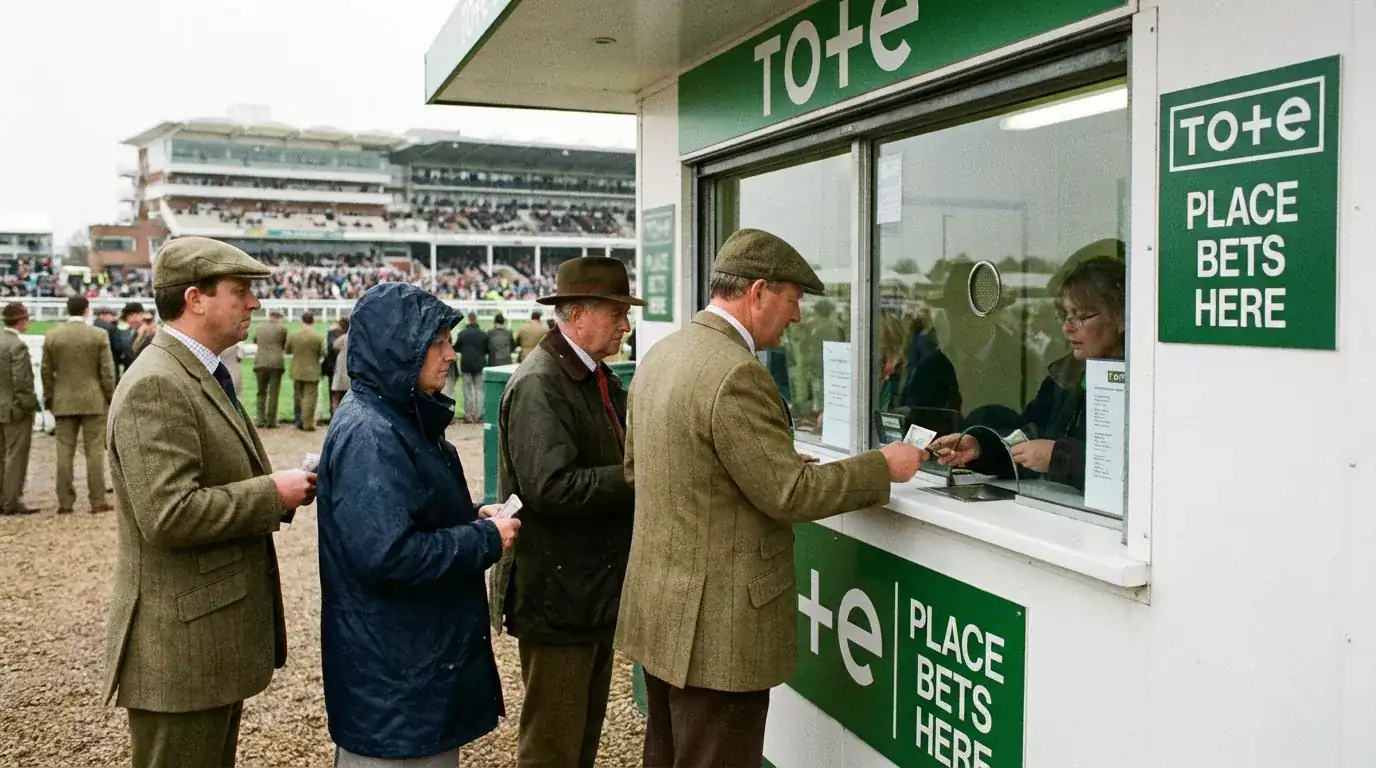
There is a third element worth noting: the pari-mutuel system used in American racing means place and show payouts fluctuate until the race starts, because they depend on the total pool and how it is distributed. UK fixed-odds place bets lock in a price at the moment you place the wager (assuming you take a price rather than starting price). That predictability is one of the advantages of the UK system — you know your potential return before the race runs, which makes pre-bet calculations and value assessments possible in a way the American pool system does not easily allow. The Tote offers a pool-based alternative in Britain, but the fixed-odds each-way product remains dominant precisely because punters prefer the certainty of knowing their terms in advance.
Mixing Win and Place: Dutching, Each-Way, and Split Stakes
The win-versus-place decision does not have to be binary. Some of the most effective approaches I have used combine elements of both, tailoring the stake distribution to the specific race and the specific level of confidence I have in different outcomes.
Each-way is the obvious hybrid, and I have covered its mechanics throughout this guide and in detail in my breakdown of place betting strategy. But there are other ways to blend win and place exposure. Split staking involves placing a larger win bet and a smaller place bet on the same horse — for example, fifteen pounds to win and five pounds on the place market via a betting exchange. This gives you heavier exposure to the win outcome while retaining a safety net, and it avoids the fixed 50/50 split that each-way imposes. The trade-off is that you need access to a place market (exchanges offer this, most traditional bookmakers do not for standalone place bets) and the maths requires separate calculations for each component.
Dutching takes a different approach entirely. Instead of backing one horse to win and place, you back two or more horses to win in the same race, adjusting the stakes so that you profit the same amount regardless of which selection comes first. Dutching is a win-only strategy, but it achieves a similar psychological effect to each-way: it broadens your coverage across multiple outcomes. The disadvantage is that your total outlay increases with each additional horse, and if none of your dutched selections wins, you lose the full combined stake with no place cushion.
My preferred hybrid for festival racing is what I call a weighted each-way approach. I identify one horse I believe can win and back it each-way at a larger stake, then identify a second horse I believe is a strong place candidate and back it each-way at a smaller stake. The win-focused selection carries the portfolio’s upside; the place-focused selection acts as insurance. This is not a formal system — it is a framework for allocating capital across a race in proportion to my confidence in different outcomes. It works because it respects the core insight of this entire comparison: win bets and place bets serve different functions, and the best approach uses both where each is strongest.
Frequently Asked Questions
Is a place bet always safer than a win bet?
In terms of hit rate, yes — a horse is more likely to place than to win. But ‘safer’ does not mean ‘more profitable’. The place leg pays at a fraction of the win odds, so the returns per successful bet are smaller. If your horse is short-priced, the place return may not even cover the double each-way stake, making a win bet the better risk-adjusted choice.
At what odds does a win bet become mathematically superior to each-way?
There is no single crossover point because it depends on the place terms and your assessed probability of winning versus placing. As a guideline, below about 5/1 with 1/4 place terms, the place leg contributes so little to the total return that a straight win bet is more capital-efficient. Above 8/1 in three- or four-place races, each-way starts generating meaningful standalone place profits.
Why do US sites use ‘show’ while UK sites use ‘place’?
The US splits finishing positions into three separate bet types: win (first), place (first or second), and show (first, second, or third). The UK bundles the win and place components into each-way bets, with ‘place’ covering all paid positions (two, three, or four depending on the race). The terminology reflects different betting market structures, not different outcomes.
Can I combine a win bet on one horse with a place bet on another in the same race?
Yes. There is no rule against placing different bet types on different horses in the same race. You can back one horse to win and another each-way, or back one horse to win and use the exchange place market for another. This is a legitimate way to diversify your exposure across a race, though it increases your total outlay.
Sources
Business Research Insights, Horse Racing Market Report 2026. grandnational.fans, industry analysis of favourite win rates 2024. Matchbook Insights, odds-on favourite strike-rate data 2024. cheltenhamfestival.fans, festival favourite analysis 2020-2025. racingtraders.co.uk, bookmaker overround analysis 2025. BHA, Written Evidence to Parliament (GAM0065) 2023.
Created by the ”win Place bet Horse Racing” editorial team.