Each-Way Lucky 15: UK Horse Racing Full-Cover Bets
 Available in US
Each-Way Lucky 15 Settlement Rules UK
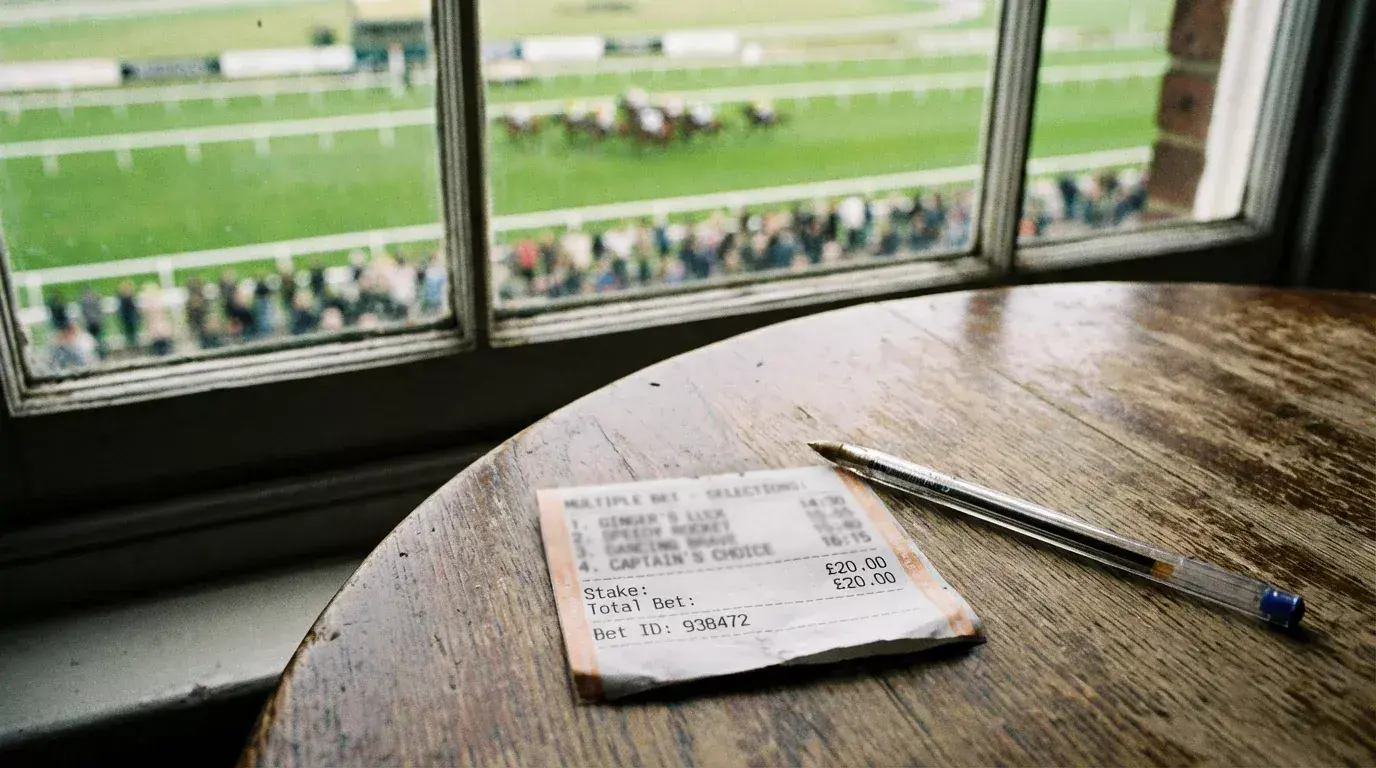
The first time I placed an each-way Lucky 15, I had to ask the bookmaker to repeat the total stake because I did not believe the number. Four horses, £1 each way, and the slip said £30. That moment of sticker shock is universal among Lucky 15 newcomers, and it is the first thing you need to understand: an each-way Lucky 15 is not one bet. It is thirty separate bets on four selections, and the maths behind it is both its strength and its cost.
Each-way bets account for approximately 22% of the UK horse racing betting market, and the Lucky 15 is one of the most popular full-cover bet types among each-way punters. Its appeal is straightforward: it gives you multiple ways to win from four selections, so you do not need all four horses to perform perfectly for the bet to pay. A single horse placing can generate a return, and if all four run well, the compounding across doubles, trebles, and the four-fold produces returns that far exceed what four individual each-way singles would deliver.
Inside the Lucky 15: Singles, Doubles, Trebles, and Four-Fold
A Lucky 15 comprises 15 individual bets from four selections: 4 singles, 6 doubles, 4 trebles, and 1 four-fold. When you place it each-way, each of those 15 bets becomes two bets – a win side and a place side – giving you 30 bets in total. At £1 per line, that is £30. At £2 per line, it is £60. The stake escalates quickly.
Here is the breakdown. Suppose your four selections are Horse A, Horse B, Horse C, and Horse D. The 15 bets are: 4 singles (A, B, C, D), 6 doubles (AB, AC, AD, BC, BD, CD), 4 trebles (ABC, ABD, ACD, BCD), and 1 four-fold (ABCD). Each-way means each bet runs twice – once at win odds, once at place odds. If Horse A wins, the win single on A pays, plus the win side of every double, treble, and four-fold that includes A is alive. If Horse A places but does not win, only the place singles and place multiples involving A survive.
The full-cover structure means that even if only one horse places, you collect on one place single. If two horses place, you collect on two place singles and one place double. Three placing: three singles, three doubles, one treble. All four placing: four singles, six doubles, four trebles, one four-fold. The returns compound through each layer, and at decent odds the place multiples alone can produce substantial payouts.
How Each-Way Settlement Splits the Lucky 15 Returns
Settlement is where the Lucky 15 earns its complexity. More than 80% of bets at the 2024 Cheltenham Festival were placed via mobile, and the ease of placing Lucky 15s on apps has made them a festival favourite – but many punters do not fully understand how the returns are calculated until they see the settlement breakdown.
Let me walk through a scenario. You place a £1 each-way Lucky 15 (£30 total) on four horses: Horse A at 8/1, Horse B at 10/1, Horse C at 6/1, Horse D at 12/1. Place terms are 1/4 odds on all four races. Outcome: Horse A wins, Horse B places (does not win), Horse C is unplaced, Horse D wins.
Win side: Horse A wins and Horse D wins, but Horse B and C did not win. The win singles on A and D pay. The win double AD pays. All other win bets (anything involving B or C winning) lose. Win returns: single A = £1 x 8 = £8; single D = £1 x 12 = £12; double AD = £1 x 9 x 13 = £117. Total win returns: £137 plus £3 in returned stakes on winning bets = £140.
Place side: Horse A places (by winning), Horse B places, Horse D places (by winning). Horse C does not place. The place singles on A, B, and D pay. The place doubles AB, AD, and BD pay. The place treble ABD pays. All bets involving C on the place side lose. Place returns: single A = £1 x 2 = £2; single B = £1 x 2.5 = £2.50; single D = £1 x 3 = £3; double AB = £1 x 3 x 3.5 = £10.50; double AD = £1 x 3 x 4 = £12; double BD = £1 x 3.5 x 4 = £14; treble ABD = £1 x 3 x 3.5 x 4 = £42. Total place returns: £86 plus stakes on winning place bets.
Combined returns well exceed the £30 outlay, even though one of the four horses was unplaced and another placed without winning. That resilience to partial failure is the Lucky 15’s primary selling point.
When an Each-Way Lucky 15 Beats Separate Singles
The Lucky 15 outperforms four individual each-way singles whenever two or more of your selections hit the frame. The singles component of the Lucky 15 is identical to placing four each-way singles – same odds, same stakes, same returns. The additional value comes from the doubles, trebles, and four-fold, which compound the returns across legs and generate payouts that four standalone bets cannot replicate.
If only one horse places, the Lucky 15 actually underperforms singles. You collect on just one place single (and possibly one win single if the horse won), and the remaining 28 or 29 bets all lose. The total return from that single placing horse is unlikely to cover the £30 outlay. With four separate each-way singles at £3.75 each way (matching the same £30 total stake), a single horse placing returns the same amount on the single but you have not wasted money on doubles, trebles, and four-folds that required multiple legs to connect.
The break-even analysis works out roughly like this: if you expect at least two of your four selections to place, the Lucky 15 structure adds value through the compounding multiples. If you expect only one to place, you are better off with singles. If you expect three or four, the Lucky 15 delivers explosive returns that far outstrip what any combination of singles could achieve.
My approach: I reserve each-way Lucky 15s for days when I have four selections that I genuinely believe will place – not hope, not wish, believe based on form analysis and race conditions. On festival Saturdays where every race is competitive and my selections are grounded in data rather than sentiment, the Lucky 15 is the bet that maximises the payoff from getting three or four right. On ordinary midweek cards where one or two selections are speculative, individual each-way singles are the sharper tool.
How many of my four horses need to place for an each-way Lucky 15 to return a profit?
As a rough guideline, you typically need at least two of the four horses to place – and ideally at least one to win – for the Lucky 15 to return more than the £30 outlay on a £1 each-way bet. The exact break-even depends on the odds of the placed horses: two placing at longer odds (10/1+) can generate enough through the place double and singles to cover the stake, while two placing at shorter odds (3/1 or less) may not. If three or four horses place, the returns from the compounding multiples usually produce a strong profit.
Do bookmakers offer consolation bonuses on each-way Lucky 15s?
Many UK bookmakers offer consolation bonuses on Lucky 15 bets when only one of your four selections wins. The typical bonus is a percentage enhancement (often 10% to 25%) on the returns from that single winner. Some operators also offer a bonus if none of your selections win but one or more place. These bonuses vary by operator and are subject to specific terms, so check whether your bookmaker offers a Lucky 15 consolation before placing the bet – it can improve the returns on partial results.
Published by the win Place bet Horse Racing team.