UK Place Terms Horse Racing: Paid Places and Odds
 Available in US
Table of Contents
- UK Horse Racing Place Terms and Fraction Rules
- Standard UK Place Terms: The Runner Threshold Table
- Handicap Races: Why You Get an Extra Place
- 1/4 Odds vs 1/5 Odds: What the Fraction Means for Your Payout
- Non-Handicap Place Terms Across Flat and Jump Racing
- When Bookmakers Offer More Places Than Standard
- Edge Cases: 4 Runners, Walkovers, and Void Races
- Frequently Asked Questions
- Sources
UK Horse Racing Place Terms and Fraction Rules
Every each-way bet I have ever placed started with the same question: how many places are being paid in this race? Not the horse’s form, not the going, not the jockey booking — the place terms. Because if you do not know how many finishing positions qualify for a payout and at what fraction of the win odds, you are betting blind. Place terms are the contract between you and the bookmaker, and they change from race to race. They are one of the first things to understand when learning how win and place bets work in UK racing.
Each-way is the second most popular bet type in British racing, and every single one of those wagers is governed by place terms that the bettor should have checked before confirming the slip. In practice, many do not check — and that is where money gets left on the table or, worse, lost to a misunderstanding.
The relationship between British racing and betting runs deeper than two centuries of shared history. Place terms evolved as part of that relationship, codified by racing authorities and applied uniformly across the sport. They are not arbitrary. The number of places paid reflects the number of runners in a race, the type of race, and in some cases the bookmaker’s promotional decisions. Understanding this framework is essential groundwork for anyone betting each-way in UK horse racing, and it is the reference point for evaluating whether a particular each-way bet offers genuine value or just the illusion of it.
Standard UK Place Terms: The Runner Threshold Table
I keep a mental version of this table at all times. After nine years, the numbers are automatic — but when I started, I had to look them up before every bet. If you are new to each-way, this is the single most important reference you will use.
The standard UK place terms work on a threshold system tied to the number of declared runners at the off. The thresholds are:
One to four runners: no place betting. Each-way bets are settled as win-only, and the place stake is returned. There simply are not enough horses to justify a separate place market.
Five to seven runners: two places are paid. The place fraction is typically 1/4 of the win odds. First and second qualify. This applies to most non-handicap races with small fields — conditions stakes, Group races with limited entries, and small-field novice events.
Eight to fifteen runners: three places are paid. The place fraction is 1/4 of the win odds. First, second, and third qualify. This covers the majority of UK races — maidens, handicaps below sixteen runners, and mid-sized fields in every code.
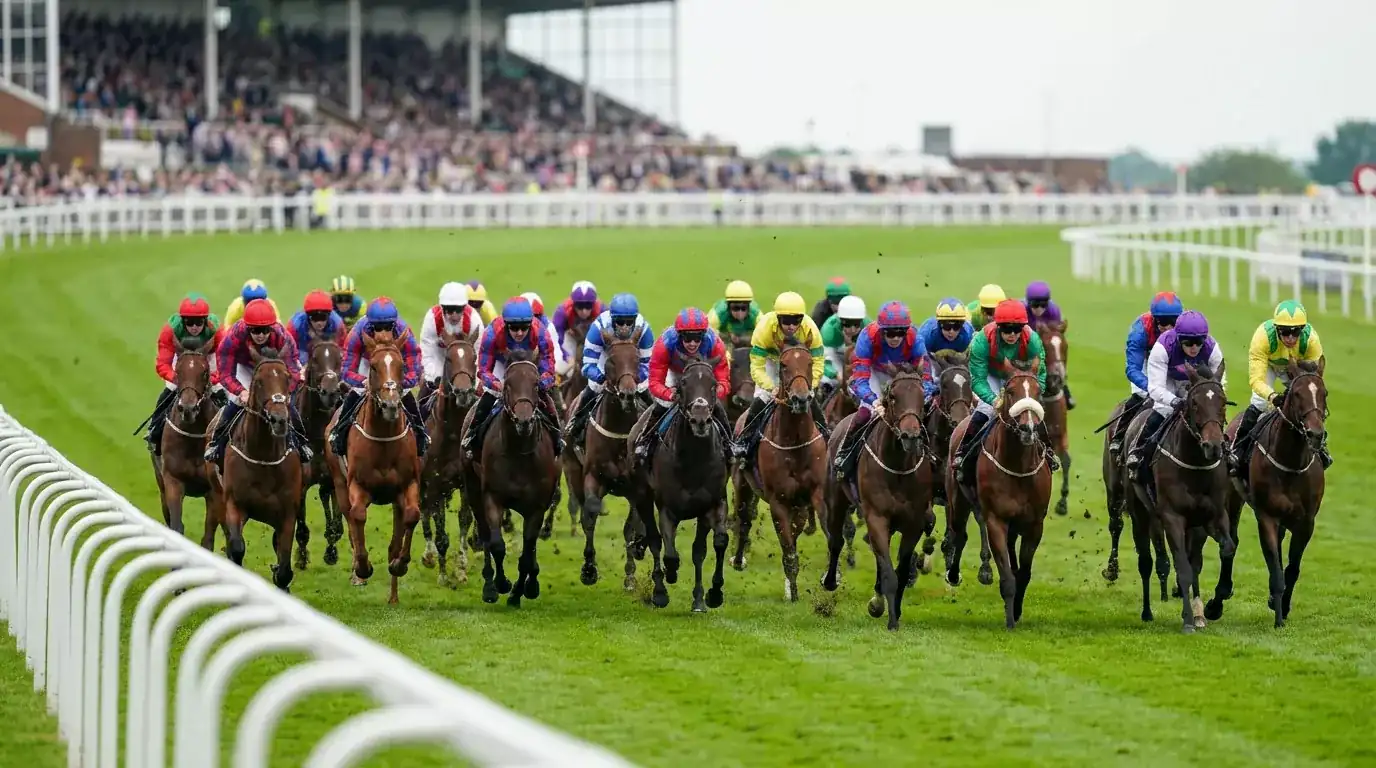
Sixteen or more runners in a handicap: four places are paid. The place fraction remains 1/4. First, second, third, and fourth all qualify. This is the most generous standard term and applies to the big competitive handicaps that dominate festival cards and Saturday feature races.
These thresholds are based on the number of runners at the off, not at declaration time. If a race is declared with seventeen runners but two are withdrawn before the start, it drops to fifteen — and the place terms revert to three places. That distinction matters, and it catches people out regularly. I have seen punters place early each-way bets on big handicaps expecting four places, only for late withdrawals to reduce the field below sixteen and cost them the fourth place. Checking the final runner count close to the off is a non-negotiable habit.
There are 59 racecourses in the UK, hosting thousands of races each year, and these thresholds apply uniformly across all of them. Whether you are at Ascot for a Group 1 or at a Monday evening meeting at Wolverhampton, the runner thresholds do not change. That consistency is one of the things that makes UK place terms straightforward once you have internalised the numbers.
Handicap Races: Why You Get an Extra Place
The first time I properly understood handicap place terms, I was staring at a twenty-two-runner Cesarewitch field and realising I had been leaving value on the table for months. Handicaps with sixteen or more runners pay four places instead of three — and that single extra place changes the entire calculus of an each-way bet.
The logic is straightforward. In a race with twenty or more runners, the probability of any individual horse finishing in the top three is relatively slim. Adding a fourth paid place reflects the larger field and the increased difficulty of predicting precise finishing positions. It also makes the each-way product more attractive to bettors, which drives turnover — something both bookmakers and the racing industry depend on.
What makes the fourth place so powerful is not just the extra finishing position. It is the interaction between field size and price. Big handicaps tend to feature runners at longer odds — 14/1, 20/1, 33/1 — because the field is competitive and no single horse dominates the market. At 20/1 with 1/4 place odds, the place leg alone pays 5/1. A five-pound each-way bet returns thirty pounds on the place if your horse finishes fourth. That is a twenty-pound net profit from a horse that did not even reach the podium in conventional terms.
The sixteen-runner threshold is specific to handicaps. A sixteen-runner Group 1 still pays three places, not four, because it is not a handicap. This distinction trips up punters who see the runner count without checking the race type. Always confirm both the number of runners and whether the race is classified as a handicap before assuming four places are available.
Big-field handicaps dominate the betting turnover on major race days. The Grand National, the Ebor, the Cambridgeshire, the November Handicap — these races routinely attract fields of twenty or more, and the four-place terms are a significant part of their appeal. Racecourse attendance across Britain topped 5.031 million in 2025, the first time the figure exceeded five million since 2019, and those big handicap events are a major draw for the race-going public and the betting market alike.
1/4 Odds vs 1/5 Odds: What the Fraction Means for Your Payout
Here is a question I get asked constantly: why does my each-way bet sometimes pay at 1/4 of the win odds and sometimes at 1/5? The answer comes down to how many places are being paid, and it directly affects how much money lands in your account.
The 1/4 fraction is the UK standard for the vast majority of races. When three or four places are paid, the place leg settles at one quarter of the win odds. A horse at 8/1 pays 2/1 on the place. A horse at 12/1 pays 3/1 on the place. A horse at 20/1 pays 5/1 on the place. The maths is clean and the returns scale in a way that keeps each-way attractive at longer prices.
The 1/5 fraction applies to races with two places paid — typically those with five to seven runners. With only two qualifying positions, the bookmaker reduces the fraction to reflect the lower probability of finishing in the places compared to a three- or four-place race. At 1/5, an 8/1 shot pays just 8/5 on the place. A 12/1 shot pays 12/5. A 20/1 shot pays 4/1 instead of the 5/1 you would get at 1/4.
The practical impact is significant. Take a ten-pound each-way bet on a 10/1 horse. At 1/4 odds with three places: the place leg pays at 5/2, returning twenty-two pounds fifty (twelve fifty profit plus ten-pound stake). Deduct the twenty-pound total outlay, and your net profit from a place-only result is two pounds fifty. At 1/5 odds with two places: the place leg pays at 2/1, returning fifteen pounds. Deduct the twenty-pound total outlay, and you are five pounds down despite your horse placing. That is a seven-pound-fifty swing purely from the fraction change.
The bookmaker’s margin on place bets is larger than on win bets, and the 1/5 fraction compounds this effect. In small-field races with 1/5 terms, the combined margin on the each-way product can be punishing. This is why experienced bettors are more cautious about each-way bets in five-to-seven-runner races: the fraction is less generous, the number of paid places is smaller, and the bookmaker’s edge is wider.
My rule of thumb: treat 1/5 races as inherently less each-way-friendly. They are not unplayable, but they demand a higher win price to justify the double stake. At 1/4 odds, each-way becomes genuinely attractive at around 5/1 and above. At 1/5, I rarely consider it below 8/1.
Non-Handicap Place Terms Across Flat and Jump Racing
Handicaps get the headlines for each-way betting, but a huge proportion of UK racing is non-handicap — maidens, novice races, conditions stakes, Listed races, Group races, and championship events. The place terms for these races follow the same runner thresholds, but the dynamics are different because the field sizes tend to be smaller and the market formation is less competitive.
On the Flat, non-handicap races frequently attract fields of five to ten runners. Group 1 races might have six or seven entries. A conditions stakes at a midweek meeting might have five. At these field sizes, you are operating in two-place or three-place territory with 1/4 or 1/5 fractions, and the favourite is often dominant. Flat racing conditions races rarely produce the large, open fields where each-way excels, so the place terms reflect a tighter, less forgiving market.
Jump racing tells a different story. Novice hurdles and chases, even non-handicap ones, routinely attract ten to fourteen runners. The nature of jump racing — the physical demands, the obstacles, the higher attrition rate from falls and unseating — means that form is less reliable and the favourite is less dominant. Novice chases in particular are each-way gold because inexperienced chasers frequently make jumping errors, opening up places for horses further down the market. Three places paid at 1/4 odds in a twelve-runner novice chase is a substantially more attractive proposition than the same terms in a six-runner Group 2 on the Flat.
Listed and Group races sit in a middle ground. They attract higher-quality fields but limited runner numbers. A Group 3 handicap might have fourteen runners and pay three places. A Group 1 might have eight runners but with three places at 1/4, the quality of the field makes place predictions harder than the numbers suggest. The key distinction is always the same: check the runner count, confirm the race type, and know your fraction before you bet.
One pattern I have noticed over the years: non-handicap jump races in the autumn and winter months tend to have the largest fields of any non-handicap category. November novice hurdles at tracks like Cheltenham, Newbury, and Haydock regularly attract twelve to sixteen runners because trainers are eager to get unraced or lightly raced horses started. That creates a brief window where non-handicap place terms are at their most generous — three places in fields of twelve to fifteen, sometimes even flirting with the sixteen-runner threshold if the entries hold. Flat maidens early in the turf season can show a similar pattern, though the fields rarely grow as large. Being aware of these seasonal rhythms helps you anticipate when non-handicap each-way betting becomes more viable.
When Bookmakers Offer More Places Than Standard
Standard terms are the baseline, but they are not always the ceiling. Bookmakers regularly offer enhanced place terms on selected races — typically the big televised events that drive the highest betting turnover. These “extra places” promotions add one or more additional paid positions beyond the standard threshold, and they can materially shift the value of an each-way bet.
A typical example: a sixteen-runner handicap hurdle at Cheltenham normally pays four places. A bookmaker might offer five or even six places on that race as a promotional incentive. Your horse finishes fifth — outside the standard four places, but within the promotional range. Under standard terms, both legs of your each-way bet would lose. Under the enhanced terms, the place leg pays and you collect a return.
The commercial logic is transparent. Extra-places promotions attract bettors to a specific operator, drive account registrations, and increase race-day engagement. They are particularly common during the Cheltenham Festival, the Grand National meeting, Royal Ascot, and the major Saturday race cards that generate the highest media coverage and the most competitive fields.
Are extra places always valuable? Not automatically. The extra place is typically offered at the same fractional odds as the standard terms — 1/4 in most cases. The additional place adds a genuine edge only if your selection’s probability of finishing in that extra position is meaningful. On a horse priced at 33/1 in a twenty-four-runner handicap, the probability of finishing fifth or sixth is real, and the place return at those odds justifies the double stake. On a 4/1 second favourite, the extra place adds marginal value because the horse is already likely to finish in the standard places if it finishes in the frame at all.
I treat extra-places promotions as a tiebreaker. If I am undecided between two bookmakers for the same bet, the one offering an additional place gets the business. But I do not restructure my entire approach around them. The standard terms are the foundation; enhanced terms are a bonus that occasionally tips a borderline bet into value territory.
Edge Cases: 4 Runners, Walkovers, and Void Races
Most of the time, place terms are straightforward. But racing produces situations that test the rules, and knowing how they are handled prevents unpleasant surprises on your betting statement.
Four runners or fewer means no place market. If you have placed an each-way bet and the field drops to four runners after withdrawals, the place part of your bet is voided and the stake returned. The win leg stands as a normal win bet. This can happen on the morning of a race when late non-runners are announced, and it can happen at the start if a horse is withdrawn at the gate. The timing matters: if the withdrawal happens after betting has opened, the place stake comes back to you; if you bet ante-post on a race that eventually has four runners, the same rule applies.
Walkovers — where only one horse goes to post — void all each-way betting entirely. There is no race in any meaningful sense, and the bet is settled as a non-runner. Your full stake is returned. Walkovers are rare in modern racing but they do occur, usually in small-field conditions races where all but one horse are withdrawn.
Void races arise from various causes: abandoned meetings (weather, safety), false starts that cannot be re-run, or administrative errors. In a void race, all bets are void and stakes are returned. If a race is part of an accumulator, it is treated as a non-runner and the accumulator recalculates without that leg.
One edge case that I find particularly important: the interaction between late withdrawals and place terms in borderline fields. A race declared with eight runners pays three places. If one horse is withdrawn at the start, the field drops to seven — and the place terms should technically revert to two places. In practice, most bookmakers settle based on the number of runners at the off (after all withdrawals), not the declared field. This means a bet placed when eight runners were declared might be settled under seven-runner terms, reducing your places from three to two. Some bookmakers display “subject to change” warnings on place terms for exactly this reason. Always read the small print, and if possible, place your bet as close to the off as practical when the field size is on a threshold boundary.
Frequently Asked Questions
Do place terms differ between Flat and National Hunt racing?
The runner thresholds are the same across both codes: two places for five to seven runners, three for eight to fifteen, four for sixteen-plus in handicaps. The practical difference is that jump racing produces more large-field races and higher attrition, which makes four-place handicap terms more common during the National Hunt season.
Why do 16+ runner handicaps pay four places instead of three?
The fourth place reflects the increased difficulty of predicting finishing positions in large, competitive fields. With sixteen or more runners, the probability of any single horse finishing in the top three drops significantly, so the additional place broadens the each-way product and makes it more attractive to bettors.
What place terms apply to races at Cheltenham and the Grand National?
Standard runner thresholds apply. Most Cheltenham Festival handicaps attract sixteen or more runners, so four places are paid at 1/4 odds. The Grand National, with up to forty runners, also pays four places at standard terms — though many bookmakers offer extra places as promotions for these flagship events.
Can a bookmaker change place terms after I have placed my bet?
Standard industry place terms are based on the number of runners at the off. If late withdrawals change the runner count, the place terms adjust accordingly. Enhanced promotional terms (extra places) are typically locked in at the time of bet placement and are not reduced by subsequent withdrawals, but you should always check the specific bookmaker’s rules.
Sources
Business Research Insights, Horse Racing Market Report 2026. BHA / Windsor Racecourse statistics on UK racecourses 2025. BHA 2025 Racing Report, attendance figures. racingtraders.co.uk, bookmaker overround analysis 2025. European Commission, State Aid clearance of Horserace Betting Levy reforms 2017.
Written by the editors at win Place bet Horse Racing.